





Table of Contents Show
current version: v1.1
Received the People’s Choice Award (Doncaster Art Fair) 2023

Listen this Article:
Description
Nostalgie World is an ongoing interactive installation and illustrated universe that stages mental health as a lived condition inside contemporary media reality.
The work begins from a simple unease: in the age of social feeds, attention is not only something we have; it is something we inhabit.
A feed does not simply display the world. It trains perception through repetition, salience, interruption, and the quiet pressure of comparison. Over time, it shapes what feels visible, desirable, urgent, and emotionally real.
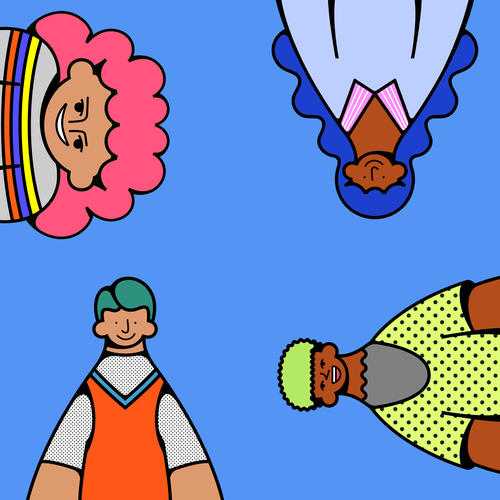
Nostalgie World unfolds through a population of thousands of generative characters, each visually unique and each paired with a mental health related narrative.
These figures appear across world illustrations (comic-like scenes and environmental fragments) and within an explorable 3D space, the Emotion Explorer; where visitors navigate, choose a character, and read their story.
The encounters often become intimate.
In exhibitions, visitors repeatedly gravitate toward characters that feel like mirrors: figures that resemble them, echo their inner weather, or recall someone they miss.
Nostalgie World treats that instinct not as “user preference”, but as a philosophical center of the work:
The human need for recognition meeting the algorithmic logic of personalization.
The work situates itself inside a global reality:
WHO estimates that in 2019, 970 million people were living with a mental disorder, and WHO’s newer data notes that in 2021, nearly 1 in 7 people (1.1 billion) were living with a mental disorder.
The installation does not claim to diagnose, treat, or replace care.
Instead, it builds a space where mental health can be encountered as plural, narrative, and socially shaped, and where attention can be practiced as something closer to care than capture.
Originally developed as an art installation and generative storytelling system, Nostalgie World later became the conceptual foundation for Bonded Studio, a connection studio for a less lonely world.
Where Nostalgie World explored recognition, mental health, and attention inside the feed, Bonded Studio extends that research into loneliness, closeness, digital contact, physical connection, and the future of human relationships.
Methodology
Nostalgie World is built as a world-system:
One visual system and one narrative system, designed to operate together.

Generative character construction
A modular illustration system generates characters through combinatorial assembly (facial features, bodies, accessories, clothing), including rarity-weighted traits that produce a statistical ecology of difference.
Each character stores a metadata signature recording the exact assets used to generate them.

LLM narrative generation
Each character’s metadata becomes a unique input into a custom prompt structure used with an LLM, producing a story tied to that specific visual identity.
The intention is not clinical authority, but emotional legibility:
Narratives that function as containers for lived feeling and mental-health experience rather than as diagnostic statements.
Corpus review and validation workflow
The narrative corpus (stories tied to each character) is treated as material requiring audit, not as “AI truth”.
Outputs are reviewed through clustering and similarity checks (including t-SNE visualization) to detect repetition, drift, and thematic density.
Plagiarism checks and comparison against publicly available discussion contexts are used as a grounding mechanism for tone and plausibility.
Interaction design and ethics
The Emotion Explorer is intentionally simple:
Explore → select → read → reflect
The project rejects the extraction logic of mainstream platforms: no visitor data is collected.
The work offers encounter without profiling, retention mechanics, or behavioral capture.

Conceptual Framework
1. Attention as an environment
Nostalgie World is anchored in the idea that attention is structurally scarce in an information rich world.
Simon’s foundational formulation, information consumes attention, frames the present as an attention-allocation problem, not a personal failure of willpower.
The feed becomes a cultural technology of allocation: it decides what becomes visible, repeated, and emotionally “real”.

2. The attention economy and the politics of capture
The work reads platform culture as an economy built around capturing and reselling attention.
In parallel, critiques of surveillance capitalism argue that digital systems increasingly transform lived experience into extractable data for prediction and influence (Zuboff, 2019).
Nostalgie World repurposes computational methods from this landscape; generation, personalization, patterning but turns them toward a counter-ethic:
From optimization to empathy, from capture to contemplation.
3. Social feeds and mental health risk
The project does not reduce mental health to a single causal narrative.
But it takes seriously the growing institutional consensus that we cannot assume social media environments are “safe by default”, especially for young people.
The U.S. Surgeon General’s advisory and the APA advisory both emphasize that impacts vary by context and that harms and risks warrant mitigation, transparency, and responsibility.
Nostalgie World translates this into form:
It asks what happens when emotional life is continuously shaped by interruption, metrics, and algorithmic relevance and what it means to build an interface that refuses those incentives.
4. Nostalgia as interface (memory as navigation)
“Nostalgie” is treated as memory-as-interface; the past as a navigational surface we return to when the present becomes too fast or too loud.
The illustrated world borrows the intimacy of character universes not to escape reality, but to approach difficult emotional material through a language that feels accessible.

Mediums
Title: Nostalgie World
Year of Creation: 2022 – 2026 (ongoing)
Technologies: Javascript, AI models, React, Three.js, Photoshop, Orange3 (data-analysis)
Type: Generative character world; illustrated universe; interactive 3D installation; web-based experience; internet-brand
Acknowledgements: Adamantia Chatzivasileiou (Elements & World Illustrations).
From Nostalgie World to Bonded Studio
Nostalgie World began as an experiment in attention, recognition, and emotional storytelling.
Over time, the work revealed a larger question:
What happens after recognition?
If a person sees themselves in a character, a story, a world, or a fragment… what kind of connection becomes possible next?
That question became the bridge into Bonded Studio.
Bonded Studio expands the emotional and technological research of Nostalgie World into a broader cultural studio exploring loneliness, closeness, play, sensory design, digital contact, and real human connection.
Nostalgie World remains the artwork.
Bonded Studio is the world that grew from it.

References
American Psychological Association. (2023). Health advisory on social media use in adolescence.
Office of the Surgeon General. (2023). Social media and youth mental health: The U.S. Surgeon General’s advisory. U.S. Department of Health & Human Services.
Simon, H. A. (1971). Designing organizations for an information-rich world. In M. Greenberger (Ed.), Computers, communications, and the public interest (pp. 37–52). Johns Hopkins University Press.
Zuboff, S. (2019). The age of surveillance capitalism: The fight for a human future at the new frontier of power.


